

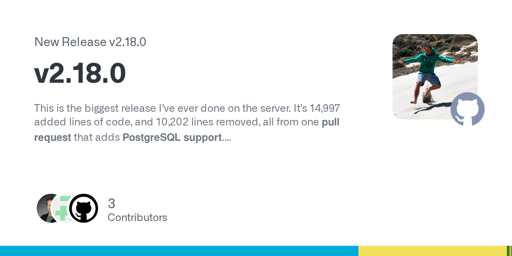
According to the release:
Adds experimental PostgreSQL support
The code was written by Cursor and Claude
14,997 added lines of code, and 10,202 lines removed
reviewed and heavily tested over 2-3 weeks
This makes me uneasy, especially as ntfy is an internet facing service. I am now looking for alternatives.
Am I overreacting or do you all share the same concern?
Not to pick at nits, but it would be VERY different if it was 1k lines added and 24k lines removed. There’s something extremely satisfying about removing 10k+ lines of unnecessary code.
Sure, that would be a little different, but unless you could make a convincing argument, backed up with a solid set of unit tests, at the least, as to why and how you were able to remove that much code whilst only adding a comparatively small amount, I’d still be inclined to reject it and ask for it to be broken down into smaller units.
Now, that explaination might be something along the lines of it being dead code that is not called from anywhere, or even that it was a patched version of an upstream library, and the patch is now included in that upstream, in which case, fair enough, good work, and thanks very much. As a rewrite or refactor though, it’s too big to sensibly review and needs breaking down into separate features.
Absolutely, the author needs to be able to reason about their changes, no matter what. However, the reason why I think the two situations are fundamentally different, though, is that it’s a lot easier to validate the existence of features than it is the non-existence of bugs or malicious behavior. The biggest risk to removing code is breaking preexisting features, whereas the biggest risk to adding code is introducing malicious behavior.