

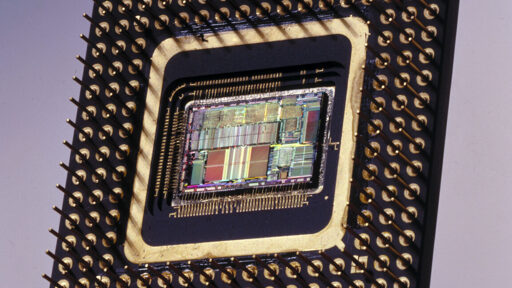
One point in favor of the sprawling Linux ecosystem is its broad hardware support—the kernel officially supports everything from ’90s-era PC hardware to Arm-based Apple Silicon chips, thanks to decades of combined effort from hardware manufacturers and motivated community members.
But nothing can last forever, and for a few years now, Linux maintainers (including Linus Torvalds) have been pushing to drop kernel support for Intel’s 80486 processor. This chip was originally introduced in 1989, was replaced by the first Intel Pentium in 1993, and was fully discontinued in 2007. Code commits suggest that Linux kernel version 7.1 will be the first to follow through, making it impossible to build a version of the kernel that will support the 486; Phoronix says that additional kernel changes to remove 486-related code will follow in subsequent kernel versions.
Although these chips haven’t changed in decades, maintaining support for them in modern software isn’t free.
“In the x86 architecture we have various complicated hardware emulation facilities on x86-32 to support ancient 32-bit CPUs that very, very few people are using with modern kernels,” writes Linux kernel contributor Ingo Molnar in his initial patch removing 486 support from the kernel. “This compatibility glue is sometimes even causing problems that people spend time to resolve, which time could be spent on other things.”
Too soon?
hopefully someone forks off a decent kernel that bridges the gap between older hardware and modern Linux because this feels like a valuable door to keep open in this regressive age of “you’ll own nothing and you’ll like it”.
I get that, but how many people are still running a 486 without a bespoke use case in 2026? The older kernels still work, and no software targeting the 486 architecture is relying on the latest Linux kernel.
As long as the PC isn’t being connected to the internet, there’s no reason you can’t just keep running an old kernel.
Even if it is connected, you can keep running an old kernel.
You can, but it’s a bad idea. Pretty major security risk.
What are you running on a 486 these days that needs to be online? A pihole? Like, even if this is a CNC controller or vinyl cutter (if you need a dongle to run your output, this is a valid concern; not a lot of parallel ports hanging out on mobos these days), the internet is not required.
We agree completely. Offline is better.
What kind of security risk are you at running a 486? You can barely handle the TLS handshake. Modern malware would just brick your system the same way any other modern software would.
I was speaking in general. Everyone’s risk tolerance is different. Offline is better if you can.
My point was more along the lines of online being impractical. Sure, you can still connect to servers running old software (in which case kernel updates aren’t useful to you anyway), but anything with modern security or software is going to just not run at all on it, whether because the software is too heavy for the processor or because it simply was not compiled for it (and cannot be).
Point is, I think we both agree that the only reasonable usecase for these processors is offline or on a separate network (LAN/tunneled/etc).
Is it?
Just use Linux 6.12 with LTS until 2029 and Super LTS until 2036.
Yeah I meant after the support window ends.
uhhh…do you have any idea how much effort would be involved in maintaining a fork of the Linux kernel, just to preserve 486 support?
it’s not.
it’s a vanishingly small install base, because of how slow and limited those chips are. the 486 had a whopping 1.2 million transistors. compare that to the big list on this wikipedia page. a few that stand out:
transistor count isn’t an exact proxy for performance, but with those orders of magnitude it puts into perspective just how underpowered that little 486 is going to be, for anything you might try to do with it in 2026.
an original, first-generation Raspberry Pi will absolutely run circles around a 486. same with going to ebay or a local pawn shop / computer refurbisher and buying the absolute oldest/cheapest used laptop you can find.
for people who already have 486s and really want to keep them going, the current Debian release still supports 486, and it’s supported until 2028 - meaning you have 2 more years of continuing to receive security updates and theoretically being safe to connect it to the internet.
and even after that, FreeBSD has “tier 2” support for 386 and higher, and NetBSD supports it as “tier 1”
and of course, nothing stops anyone from running an old kernel on their old hardware.
I would really want to know what kind of a use-case results in using a 386 or 486 computer in 2026 in such a manner that not being able to install the latest kernel updates would in any way be an actual issue.
Anything you still need a 486 for outside of hardware edge cases is handled far better and faster by a Pi Zero W, at a fraction of the power envelope. Thing is, they won’t be running Linux in that case, given vendor lock-in.
Sometimes, the issue is certification, e.g. for aerospace and medical applications - although these systems tend to run on decades-old software anyway (since changes to the software also need to be certified, which rarely happens), so it’s not like this has an actual impact.
For reference, that means the 486 has maybe as many transistors as the board that runs my 11-year-old 3D printer firmware, and that was considered something between the “absolute bare minimum” and “honestly kinda underpowered” at the time I bought it. The only thing that board does is run some loops that send basic signals to some stepper motor drivers, and some basic-ass “bang-bang” style heat control. The actual heavy lifting of organizing and sending the position controls line by line is done by a Raspberry Pi.
Even i386 felt pretty speedy when compared to 8 MHz 68k.
Yes. It was speedy enough to merit a “Turbo” button to slow it down to a reasonable speed!