“It’s just a harmless field; what’s the big deal?”
The big deal is that it’s on the heels of age verification bullshit that fascists are pushing through with the help of tech bros, so that they can eventually push all of us into a scenario where we have zero privacy.
It’s not the adding of the field itself or the fact that it can be filled with nonsense. It’s the reasoning backing it.
“But it’s the law!”
Yeah, fucking and…? It’s a stupid mass surveillance law disguised as a protection, and per usual, it’s written like vague dog shit. This is the smallest part of the wedge. More will come of this and if developers like this keep volunteering themselves to help the fascists, we will all be fucked. Here’s an alternative approach: just don’t add this. You can fight back by not fucking implementing this. Easy.
“But it’s the law!”
I was just following orders!
this same person would be chuckling to themself about how pointless this all is as he locks the door on the gas chambers.
He’s adding age verification for the internet, not sending people to gas chambers. You really need to touch grass, urgently, because clearly your dependence on the internet is not healthy.
As you sit by and let the pot get one degree hotter
manuallybreathing is making an analogy, not saying they’re the same thing.
You really need to read a book and stop projecting on the internet, it can’t be healthy.
Twenty Lessons For Fighting Tyranny
- Do not obey in advance. Most of the power of authoritarianism is freely given. In times like these, individuals think ahead about what a more repressive government will want, and then offer themselves without being asked. A citizen who adapts in this way is teaching power what it can do.
https://www.carnegie.org/our-work/article/twenty-lessons-fighting-tyranny/
THIS! Those that do obey in advance, especially trying to help impose it on the rest of us, are collaborators!!! Treat them as such!
Also, they will use it as a means to lock content they don’t want. Like in some jurisdictions it’s already forbidden to share any kind of LGBTQ information even medical with minors… Even in EU, like Hungary. Clearly this age verification will be used for this too. And people not willing to age verify will be locked out too.
It’s part of their campaign of forcing conservative ‘values’ onto everyone.
Agreed. To elaborate:
Sure, the developer is a bit of a Judas for complying in advance, but our anger should be aimed at the people with power and reach promoting these laws in the political sphere (the metaphorical Pharisees).
To those saying “it’s just a field”, please consider that the timing is a more significant statement than the addition of the field itself. Why now? If you don’t support fascism, don’t build the frameworks that support it and don’t let fascists use YOUR platforms or software to make THEIR point, make them fork it and let them fail. I don’t think many members of the senate or house would be capable of adding this themselves. I’d be surprised if they could code hello world in TI-83 BASIC. If they ask you to do it, stub your toe and call in sick. Make it really shitty. Leave in a bunch of bugs that crash the program then blame the age attestation feature to turn users against it. Use copywrited code that they’ll have to remove later due to license incompatibilities. Report your boss to HR for every indiscretion that you might have normally overlooked. Or do nothing; that’s still better than complying in advance.
We have to break the narrative that this is inevitable. There’s enough of us, with concentrated enough knowledge and influence (aka, you folks are a bunch if nerds and I love it!), that if we collectively stop, the whole train stops or derails.
wasting 32 or 64 bits for absolutely no reason is also pretty offensive in itself
wasting 32 or 64 bits for absolutely no reason is also pretty offensive in itself
Storing 64 bits, in this hard drive economy? smh
More will come of this and if developers like this keep volunteering themselves to help the fascists, we will all be fucked. Here’s an alternative approach: just don’t add this. You can fight back by not fucking implementing this. Easy.
Only thing you get out of this compared to the alternative of malicious compliance is opening yourself up to attack. You can still fight this without painting a big target on your back.
Is there any evidence that they would go after random FOSS projects that aren’t hosted or developed in the relevant jurisdictions? Don’t comply in advance.
Defenders and writers of the evil code are the ones being targeted. You have this backwards and need a mirror.
You don’t understand.
The alternative to device based private attestation which is what this is or could be part of is constant online verification by Palantir.
Is every time you want to view porn or adult content you have to verify your real identity so evil corporations and the government who pays them know exactly what your fetishes are and can blackmail you. So they know exactly what you’re posting online because you have to face-scan and ID-scan to set up an email account, a social media account, any account with anything that allows posting content online. Is training the population not to enter a date for their kids or themselves when setting up a computer or device account for the first time, once but upon demand scan their face, scan their ID, comply, sit meekly in fear because everything they do online is known.
What does this know? Your birthday. That’s nothing. As it stands it you can enter anything you want. Fight them when they come to add a verification system to this and point out parents would be in a position to set this up for their kids anyways and its just spying. Fight on stronger ground.
We’ve already lost the maximalist position. The internet scanning and ID verification has already been enacted in several states and countries and we risk a world where it becomes the norm and hosting companies drop anyone who doesn’t implement it because they’re made liable as well. This stuff won’t be repealed. People don’t live in democracies. They live in a dictatorship of the wealthy and the corporations. Your dissent doesn’t matter and it cannot reach most tech illiterate people who have far more pressing concerns than to riot over this.
This is a compromise solution and I wish more people would see it. If you can bend you don’t break. If you don’t bend and your enemy is the government they are stronger than you and they will snap you like a twig.
Linux desktop market share is too small to matter. And if you make this push fail then the only alternative, the only viable solution these politicians who are being cajoled and urged to implement this will see is online live-scan face and ID verification and it’ll sweep everything. You’ll have destroyed the internet and having saved Linux won’t matter. After that it’ll be a quick move to ban encryption that the government cannot break and ISPs will block traffic they can’t inspect. Game over. A simple maneuver from the place you force them to by refusing to cooperate and enact this compromise, privacy-preserving solution. We need strong defensible positions to protect privacy and the internet and free software and to understand that the old ways have been lost, they’ve died, they’ve been strangled and a compromise position must be taken up to endure and avoid a total loss.
They can already put it on the parents to verify if they want. Just buy age compliant devices. Stop shilling this nonsense and forcing fear and hopelessness down everyone’s throat. This is bullshit and you know it. We already have a defensible position.
It is defensible in this kind of community, but I doubt it’s defensible in a board voter base. For instance people see billionaires and are saying the government should step in and do something, because as individuals we are somewhat helpless. In this instance we’re like we can fork/we can revert so the government ideally just needs to back off. But if you ask a non-tech savvy voter (and a parent in your example) they will just see big tech and say the government should step in and do something. Has this method of governance been compromised? Sure, is this law an example of that? Sure. But what can we do? The government… Well until people can agree on that, I think we are just trying to find a compromise so that most people can easily dismiss the perspective that parenting tech is too hard. And if people can believe that typing in an age for their child and see big penalties for big tech if they ignore that age, that seems to me the placebo this situation needs.
Am I the only one that is sick and tired of explaining to clueless people why this type of legislation should be shot down. This has been going on since SOPA and PIPA in the US around 2010 or whatever. I feel like I’m blue in the face.
Parents can get child compliant devices if they want. They need to leave our shit alone. How hard would it be to fork a child resistant Ubuntu or have Mac and Windows do it so these Karen’s can protect their own damn kids. But forget the guns and pedophiles running every country in the world. Let’s just fuck with the passions of the FOSS community and open the door for more surveillance.
why is it always the .ml users coming in to defend the most tyrannical shit ever while claiming we dont truly understand it
Finally a sane take.
To take things further this whole outrage reads as a Karen screaming at a starbucks cashier and threatening to boycott the store because they asked for her name. It’s an overreaction to a minor issue, by someone who overestimate their power, directed at someone who has no real power, while the Palantir surveillance system runs on the cameras behind them.
Yep, then using linux will be illegal, great fucking idea boss
You’re welcome to be a spineless muppet trying to obey unethical laws, but I won’t be.
Nope, I am a muppet whose livelihood depends on them respecting the law. If you are from one of the godforsaken regions doing stupid laws you should vote against them, I need to comply with your laws because I need to work to feed my family.
You can call me a spineless muppet all you want but I am not the cause stupid laws exists, take it on the californianas for that crap, they elected the idiots doing this. I vote our own idiots and until now they made it clear this bullshit is not on their table, thank you wery much but I did my part.
“then you should vote against them”
Oh you think they asked if they could implement these? And btw, it’s coming to your country soon too. This is a global movement
Then i sure hope linux will not be illegal in my country too
Another collaborator, “just following orders.”
Only in California and Brazil. And I suspect neither has a shortage of people able to add this field.
Exactly, make your own fascist distro with a fork of systemd and leave the original landscape alone
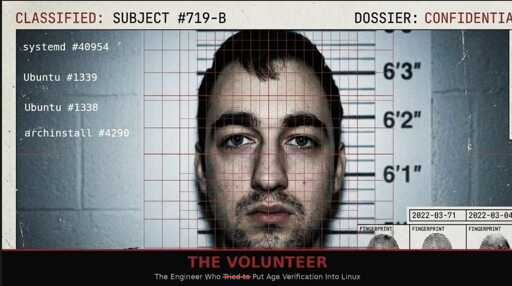
Then he said Arch Linux should implement it anyway because the law requires it. archinstall PR #4290
Well, it’s not “the law”, it’s your local law. To most people on the planet, it doesn’t apply any more than for example North Korea’s laws. As far as I can find, Arch Linux is not owned by a foundation or similar legal entity (i.e. which could have been located in California), but the lead developer appears to live in Germany.
to all y’all with the “it’s just a text field”: what if the field is “race”? “sexual orientation”? “jerks_off_to”? what the fuck has a system managing daemon got to do with any of that? and why would you preemptively put it in there without even a pretense of a fight?
fuck you make us! make linux illegal, in Cali of all places. guess how long that will last?
Yeah, scary.
What about some other scary fields like:
- Real Name
- Office Address
- Office number
- Office telephone number
- Home telephone number
- external e-mail address
I mean if those fields were stored, could you imagine the danger that Linux users would be in?
You don’t have to imagine, because those fields have been stored in UNIX/Linux since 1962. https://en.wikipedia.org/wiki/Gecos_field
I think back then it was generally assumed this simply assisted with office communication.
Imagine telling a UNIX engineer in the 70’s how almost everything you enter into a machine would eventually be used to manipulate or entrap you by the State and surveillance capitalism.
Imagine telling a UNIX engineer in the 70’s how almost everything you enter into a machine would eventually be used to manipulate or entrap you by the State and surveillance capitalism.
This isn’t a hypothetical. North Korea uses a version of Linux which does exactly that.
It still doesn’t make these fields inherently dangerous, and that same argument applies to birthDate. Even if systemd build a verification system that required photo identification and a DNA sample it wouldn’t be a problem.
The community would just fork the project before the totalitarianism update. The FOSS world already has a process to avoid massively unpopular changes. This change isn’t massively unpopular, this is a vocal minority who is stirred up by web articles leveraging clickbait and outrage to drive ad revenue.
The age verification laws are unpopular, I’m personally completely against them. However, they do exist and adding an optional field in order to allow project, who choose to do so, to store that data is not a red line or the start of a slippery slope.
In the future, if there was a red line that was crossed, we would fix it with a fork and not with a harassment campaign.
https://en.wikipedia.org/wiki/Boiling_frog
That’s you. You have no issues giving anyone an inch and then wondering why you’re being lined up on the street afterwards once they’ve taken the mile.
https://en.wikipedia.org/wiki/Slippery_slope
That’s you. You have no issue embarking on a creative writing exercise, painting the scariest possible scenario and pointing at that piece of fiction as if it were reality.
You think you can just make up lies about countries far away from you and no one will notice? Think again, whisu.
Sorry Chairman Kim
Those are also entirely optional and not having them filled in doesn’t cause other software to stop doing what the user wants.
(same for the birthDate field)
The same with the birthDate field.
… unless someone merges a PR making it required, which is the discussion of this thread.
Stored “because law”, right?
Who cares why it is stored, these fields exist for every user in every Linux system and they have existed for decades.
Either birthDate the field is dangerous or it isn’t. If it is, how?
It is no different than data fields that ask for way more identifiable and personal information such as Real Name and Office number which have, again, existed for decades without issue.
I care. One thing is “you know, fields with this name have been around since before you were born”, another thing is “some idiots passed the law half the globe away, now we are preparing your system to comply. Someone has to ©”. The field is not the danger, the thinking, attitude and act is
Edit: some local law, for fuck’s sake
Half a world away where do you live since this is happening everywhere. To be half a world away from any place doing this would be hard.

Being half a world away from Americas is pretty easy, don’t ya think?
That’s a fair argument.
Is it fair to say: The field is benign but there is contention about if it should be added or not and users of the software are concerned that their voices were not heard on the issue. That can be handled in the normal project framework, perhaps by suggesting a publicly stated policy about these issues around legal compliance so the community can determine if they want to support the project or not.
My argument is that I don’t think that the damage that was done justifies the hitpiece in the OP which is, almost literally, painting a target on the developer with the mugshot photograph and loaded language.
So, if you’re not one of the people then we’re having different conversations. In that conversation, I do agree with what you just said. I’d like to see the very large projects, which affect a lot of users, such as systemd, have a more formal way to accept public comment and respond on contentious changes and feature requests.
Is it fair to say: The field is benign
It is benign if it is optional, remains 100% local and under the user’s control and doesn’t prevent other software from functioning as expected.
It is optional, 100% local, under the user’s control and does not prevent other software from functioning as expected.
If it ever is not, then you can simply fork the project at or before that change.
It is not a hit piece. No call to action was stated.
It paints him as an active danger, puts his picture on a wanted poster, includes his full name, workplace and the city and state where he lives and then writes up an article like an after action report of a cyberattack.
It then implies that he’s going to do it again and that he can’t be persuaded and so will be ‘harder to stop’.
Taylor believes what he’s doing is right, which makes him harder to stop than someone acting for money. Taylor already has the resume line and knows the codebase well enough to try again. That’s the true believer pattern. The argument is ideological, so persuasion is off the table.
So if he’s done a bad thing, he’s going to do it again, and you can’t persuade him.
If you can’t read the implied call to action then you’re being deliberately dense.
To be fair, I am bit split on this. On one hand, name and shame is an effective strategy and should be used. On the other hand, “put age verification into Linux” is a hilarious stretch. And yes, it feels strange that I have yet to see any kind of response from other systemd maintainers and managers - after all, the man authored a pull-request, not merged into into upstream. I have not been looking for that kind of response myself though, which also serves your point: putting all the blame and anger on this one man (I purposefully omit name) is too much
Ah, but this time the government wants it to be able to be queried so that applications and web sites can decide what to do with you. That’s the difference.
The government’s wants are not in the PR. The PR is an optional JSON field.
The field isn’t dangerous, you’re conflating two different things.
The age verification laws are the threat, not an optional text field or the developer who added it.
Compliance in advance is also a threat. Do not comply, do not begin to comply. It’s a fascist law. Any compliance is collaborating with fascists.
Your argument is an informal fallacy called Whataboutism.
I invite you to educate yourself by reading about it on Wikipedia
deleted by creator
You must be off by a decade. Your reference mentions no OS and Unic was developed around 1970.
Your reference mentions no OS

2000s: war on general purpose computing because of copyright
2020s: war on general purpose computing because of child protection
In the 2000s the forces of freedom mostly won, e.g. https://en.wikipedia.org/wiki/Consumer_Broadband_and_Digital_Television_Promotion_Act didn’t become law. So far it seems that we are currently losing. :(
In Europe too, chatcontrol keeps being pushed no matter how often it’s being struck down.
Yes; recent news have made me somewhat optimistic that the resistance to it is winning though.
Age verification laws currently look like a much greater danger to freedom.
Personally I think that win (while really a win) is being overcelebrated.
It’s easily reverted. All they’ll have to do is find some csam or terrorism related scandal in the news and pump it as a big deal, and all the resistance will be gone at the next vote.
With chat control we actually have to distinguish two different things that people sometimes confuse:
- voluntary chat control (“chat control 1.0”), which is currently already the law in the EU
- mandatory chat control (“chat control 2.0”), proposed in 2022
Voluntary chat control is about letting operators of communication services voluntarily scan messages for certain illegal activity (without this constituting a violation of data protection laws). This doesn’t break encryption and isn’t a part of a war on general purpose computing. While there are many good arguments against it, it’s not especially catastrophic. It’s a detail of business regulation.
Mandatory chat control is about forcing them to do so, which must necessarily break encryption and impose limits on software freedom. This is what is most important to oppose.
The most recent win ended up rejecting even (most) voluntary chat control, which is a good sign that mandatory chat control won’t get a majority either.
It has very nearly got a majority several times. I’m sure that with some media manipulation (eg milking an incident) it will be easily pushed through.
Imagine if the Dutroux scandal would happen now. They’d jump on that to push all kinds of monitoring on everyone. Even though this would not be prevented by it in any way (and in fact that all happened long before WhatsApp even existed)
It has very nearly got a majority several times. I’m sure that with some media manipulation (eg milking an incident) it will be easily pushed through.
“Several times”? There were two votes to date.
The only “majority” we’ve been hearing about were the “these governments support this idea” maps, which have minimal bearing on how the EU Parliament actually votes.
Correct me if I’m wrong.
I hear you 100%. This sort of shit comes back with a different name each year. I am SOOOO sick of voting down abortion bans every election cycle.
26 US states, including mine, have initiative or referendum processes allowing citizens to place an issue on the ballot. In some states, that’s how the anti-abortion laws are ending up on the ballot, but we an use their own tools against them. In many states, these initiatives failed so we know we have a minimum of 51% support if it’s a law, and at least 33% support if it’s an amendment (depending on that state and their rules). Polling shows, an even larger percentage, most Americans, do not support these laws. The numbers are on our side.
https://ballotpedia.org/States_with_initiative_or_referendum
If we can collect enough signatures, the voters can put an end to this. If we add it to the state constitution, where the process allows this, we can completely prevent laws doing this from being considered because the only thing that can overrule a constitutional amendment is another constitutional amendment.
I’m gauging interest to do this in Colorado to foil age attestation laws, but we could potentially end the back and forth bullshit in multiple states.
Fucking fascists arent ever going to stop. They want to control everything, they want the people to be their slaves.
It gets worse every day.
I love the level of disdain the linux community has for this kinda bootlicking.
I have read the git thread related to the merge request.
I don’t see what’s the big deal. You have a user model that already contain fields like user’s full name, location, … among others and all this developer did was adding yet another optional field called date of birth.
This does nothing to verify user’s age and enforce nothing. They’ve stressed that repeatedly in the comments.
What that does is making it easy for a Linux distro to store user’s birthday - should they wish to do so - and making that bit of info accessible to running apps so that each app can do what it wants with it.
User’s fullname and location are already there which are also optional so what’s the big deal?
For me the bigger problem is that was done without any community oversight.
Yeah it can be verified for now, but it’s a foot in the door for a braindead law that no one in their right mind would follow.
What do you mean. It’s done in public
Yeah and against the massive outcry in the form of comments, the discussion was locked, and the general opinion was ignored in favor of 2 maintainers and a tool of a dev.
The person who has the most blame here is the lead dev of the project imo.
Why do you think this was locked? This fucking thread is a mugshot of a dev contributing to an open source project.
So they knew it was against the community and went right ahead?
There wouldn’t be “this” thread if they had taken the community into consideration.
This isn’t the gotcha you think it is. That “engineer” is
contributingbullhorning this bullshit on multiple Linux based repositories.The community is not against compliance, a loud minority is. The implementation is not where discussion needs to happen, as any software dev that had to implement shit they did not agree on, it rarely has a positive effect at this level
So they knew it was against the community and went right ahead?
Blaming the victim, beautiful.
1000x this.
It doesn’t matter how much you disagree with the change, brigading harassment is gross and should be called out every time someone tries.
This post should be nuked.
The thread was discussing age verification from what I read, but I read it when it was already locked.I do not think harassment of the dev is appropriate and the article and this post is also needles drama imo. But the issue of age verification itself I think should be discussed by the community and not just accepted by one dictator.Edit: I misread that you were talking about the GH thread. Yeah this thread is kinda shit, but discussion on how and if age verification should be done is important imo.
discussion on how and if age verification should be done is important imo.
I completely agree.
I’m very against these age verification laws… but I focus my efforts on the politicians and companies like Meta who are actually trying to implement them.
This thread is a doxxing and harrasment campaign and should have been deleted in the first hour.
The problem is that Poettering is all in on attestation which is the underpinnings of age verification and remote attestation.
See amutable.com
Poettering has always been a piece of shit.
POS or not this is a reoccurring problem with open source. The benevolent dictator for life. Hopefully we can grow past it in the coming years.
Fork it and create a democratic project, nobody is stopping you. Wanna know projects that are very open and democratic? FreeBSD and OpenBSD. Wanna know why they aren’t as popular as linux?
Then why did they lock the fucking thread as controversial if it was such an innocent change?
It’s paving the wave to implement a Californian law that can very easily end up meaning ID verification for everything.
They could just not have done this at zero cost but decide to go to multiple projects, at this specific time which obviously isn’t coincidental, and actively work to start implementing this on Linux. I guess “Contributed to systemd” on their CV was more valuable than resisting the USA taking control of the whole internet and ending all sense of privacy.
Fields like name and location do not have any expectation for the information being valid or accurate (see eg.:
adduser).DOB is different. It comes from a legal expectation that correctness of the information will be enforced somehow. If going by the Colorado and NY law proposals, IIRC, by using biometrics at the time of system install.
DOB is different. It comes from a legal expectation that correctness of the information will be enforced somehow.
[citation needed]
…Have you eve been following the news and the law proposals? I’m not sure you are engaging in good faith here.
I know what’s been going on.
However, the statement “legal expectation that correctness of the information will be enforced somehow” requires proof because it’s currently not true.
not even said laws have an expectation that the date of birth provided would be accurate. the colorado bill just says “require[] an account holder to indicate” and never defines “indicate”, the ny bill says “request an age category signal” and never defines “signal”, so i assume they’re like the california law which has been verified to be just “enter your date of birth in this text field/dropdown and we’ll trust you girl”. i don’t think any of that involves biometrics
there’s no alien intelligence or protocol specification in systemd that ensures or says the dob field must be accurate either
Wow, picking choice words only in sections of the laws and proposals. At least try and engage in honest discussion, mate,
Honestly, just go check Ageless Linux’s site. They have a complete rundown on how and where does each law’s expectation come from.
Just one (1) example:
SB 142 — App Store Accountability Act
Requires “commercially reasonable” method. In other words, the powerful agents of the market (the Googles, the Facebooks, the NSAs) get to choose what you have to do to validate. Could even require biometrics.
there’s no alien intelligence or protocol specification in systemd that ensures or says the dob field must be accurate either
That’s because systemd, a well-known Microslop infection into the Linux ecosystem, is using the wayland playbook: specify nothing, leave to other projects the task and legal weight of implementation. All systemd has to do is to ship the field, then other projects are delegated the task of entering in a “legally compliant” way.
You specifically named the bills from Colorado and NY. They simply do not include those. https://leg.colorado.gov/bills/SB26-051 https://www.nysenate.gov/legislation/bills/2025/S8102/amendment/A I wholeheartedly believe my characterization of these bills are faithful.
Specifically due to how barebones it is, it is trivial to modify yourself the birthdate sent to applications, as long as you have the system password.
It’s definitely wrong to degrade or harass this guy for doing it.
Buuut this is being made to support a bad law that should be opposed. The law is a bellwether for compulsory age and identity verification, which should strike fear into the hearts of everyone. And especially everyone who cares about their privacy (which really should be everyone, but …).
Furthermore, it’s questionable whether a law like this can apply to open source software. IMO it really can’t - who exactly is liable? Is the world really better with ageless Linux outlawed?
This is one of the most sensible comments in the thread. The law is the problem. This is something which should have been self regulated by websites themselves, but Meta lobbied for laws like this so they wouldn’t have to police it. The law making this mandatory for everyone when this should be a parental control is the issue.
This is a law that companies are required to implement or stop making business in the states enforcing that law.
You probably feel that companies should just stop doing business in those states “to show them”. Sadly a lot of profitable Linux companies that fund Linux development disagree with your high morals. They want to continue doing business there.
Adding that field help those company comply with the law and doesn’t hurt you in anyway except maybe taking few bytes in your disk drive.
Even if the field is not added, those companies would come up with another place to store date of birth or even use systemd fork.
Its not like they will say since we can’t store date of birth in systemd’s user model then we’ll have to abandon this project and close our branches in those states instead.
Yes it’s technically trivial. I have read the patch. That’s beside the point, which is social and political.
I get to decide and report what does and does not hurt me thankyouverymuch. And I do think this is a step that erodes my right to privacy, taken with shockingly little discussion. (Which got it reverted)
There’s a lot of degrees of freedom between “just comply bro” and “good luck enforcing that”. For example https://blog.system76.com/post/system76-on-age-verification
Exactly. There’s a massive thread on Mastodon where everybody is panicking about this, but it’s a nothing burger if ever there was one.
Sure, the timing and comments suggest it’s meant for legal compliance, but if that’s what it does, it does it by keeping full control in the hands of the user, where it should be.
If anyone is panicking, ask them how they feel about the ‘RealName’ field that has been in systemd for years (since the beginning?)
This is fake controversy and now it’s at the point where people are spreading articles, like the OP, brigading people into harassing a systemd developer.
Exactly. And that’s the part that worries me most: I’m seeing people investigating the guy, shaming him (he wrote a blog about using Claude to write a game in 90 minutes, so clearly he must be evil /s), and the article above is written in such a way to insinuate all sorts of nefarious goings on, but everything I see suggests this is just normal procedure.
I really feat this is going to hurt the community and chase good developers away.
Ask yourself if “RealName” field was added in response of a requirement that’s supposed to assist with a bullshit law backed by a mega evil corp?
No?
Then how’s it comparable?
Then how’s it comparable?
Because they’re both optional fields that have absolutely no checks on them where you’re free to enter any information or none at all.
In this hypothetical threat that you’re worrying about, there is no world where birthDate gives an ‘evil corporation’ more data about you than your REAL NAME and LOCATION.
Those fields have been in systemd since the beginning, have you noticed any problems related to using your Real Name and Location in your user profile… or do you simply not enter that data?
What a pointless drama article this is. FLOSS software does stuff for legal compliance more often than you’d think. The whole point is people can contribute fly by patches and the maintainers make the decision to merge. It seems like being an optional field but potentially providing useful functionality is enough for systemd. If you don’t like it I’m sure there are forks you could join or even use a different init system. No one’s freedom is being oppressed here.
What a pointless drama article this is.
Yep. The crypto ticker at the bottom of the page is the cherry on top!
It’s literally an optional birthDate field in a place where there’s already realName, emailAddress, and location. If you’re concerned about privacy, maybe don’t expose your real name, email, and location.
And it’s not even fucking installed everywhere:
$ userdbctl
Command 'userdbctl' not found, but can be installed with:
sudo apt install systemd-userdbd
Anybody who is calling this age verification is actively lying to you!
This Sam Bent guy should fucking get bent.
It’s brigading harassment on a volunteer dev, the post should be nuked this is just doxxing for ad revenue… disgusting
It was posted by Yσɠƚԋσʂ themselves, who moderates several lemmy.ml communities. I agree it should be nuked, but it’s not going to be nuked.
That’s good to know, I don’t want to be supporting communities which allow this kind of toxic garbage
That isn’t really the point. All this nonsense happened without community discussion beforehand.
Who are the community employing? Why do they need consulting before code changes are made?
Your comment is nonsense.
I think what ze’s saying is https://mikemcquaid.com/open-source-maintainers-owe-you-nothing/ . the nature of open source—atl in accord with the hacker ethic—is that everything is just a passion project, there is no responsibility to not make bad decisions, and bad decisions result in decreased adoption and lost trust. after all, open source has always been about making a new alternative because existing solutions are bad.
So we aren’t supposed to talk about or react to said bad decisions? Come on.
nah as an anarchist i am against silence. i’m just saying that in our capitalist society open source maintainers do not in fact have responsibility to the community, only to their market share, and this works slightly less dysfunctionally than proprietary because come what may the opposition may fork it. but that and the transparency and the ability to volunteer your labor for them are the only things that open source does guarantee.
So we aren’t supposed to talk about or react to said bad decisions? Come on.
Do you want to post your real name and place of work online for everyone to see or do you understand why that kind of action is dangerous and wrong?
What in the fascist fuck are you talking about
Discussions happen after the PRs in most projects, because there is no point discussing code that ain’t there.
And they usually don’t get pushed through when discussion is just starting.
My OS should have no details on me besides the account name which didn’t necessarily correspond to my real name.
It does have some old fields for location etc but those stem from the times of massive multi user systems.
Linux has similar fields for realName, emailAddress, location, timezone and more. But like birthdate, I think they’re all optional.
Was Linux ever used for massive multiuser systems? I thought it had always been primarily home use and internet servers. I think big multiuser systems went out of fashion with Solaris. Well, I suppose corporate workstations need user accounts where some of these are set.
No Linux as such was not, by the time Linux got popular the big multiuser systems were on their way out. I still worked on those in college. But they were SGI, HP-UX and Sequent. Especially the latter were huge systems.
But these fields were just a clone of what was in the original Unix systems.
Lots of disingenuous comments in this thread regarding the change being “just json” considering they’re already on a warpath of implementing id verification. They are testing the water to see what they can get away with. Furthermore, the Linux community has always been against shit like this (see: systemd outrage, open bios, gnu etc).
I’ll believe that if and when they actually force me to upload identification to prove that my birthday really is 1970-01-01 and my name really is Nunya Bissnis. Otherwise, it’s really no different from Steam asking my birthday when opening store pages or porn sites asking “click here jf you’re 18” and take my word for it.
So long as it’s being enforced just as well as the realName field, I maintain that it is indeed harmless. If the point is to have a hilariously ineffective solution as a fig leaf against a stupid law, I’ll prefer that to efforts to actually implement verification.
It’s not harmless, that’s the thing. Its just the thin end of the wedge.
“Do not comply in advance.” There is simply no need for this. Resist because it’s our duty to do so in order to keep our freedoms. Start with, “why are they doing this?” Then go follow the money. Zuckerberg and Meta, that’s why. They have been under the gun for years to protect people, especially minors, from the harms of their attention based economy of apps. They hired lobbyists in multiple states to push this legislation. Why? Because if the OS does it, they don’t have to, and can blame all the problems on the OS. What’s the Meta business model? Gather data and sell it. The more accurate and targeted the data, the higher the price. What do these laws do? Add more data. Why doesn’t Apple, Google, and Microsoft resist? They already have the infrastructure and are data gathers themselves. Why does the government allow this (US and all 5 eyes)? They LOVE surveillance.
Sincerely, thank you for spelling it out to the rest of the class.
These things are always worded ‘agreeably’ enough that by the time we’re done going back and forth debating it all day, they’ve pushed even more invasive policies on us.
I try to explain to people a lot. If you like freedom, and you want to keep it, it’s a constant fight. The power structures are far more profitable without it, so they’ll undercut it every chance they get. “Give an inch they take a mile.” Don’t give them the inch.
We are well past the thin wedge. The thin wedge was American companies purchasing every tech company or stealing their ideas.
I’ll believe that if and when they actually force me to upload identification to prove that my birthday really is 1970-01-01 and my name really is Nunya Bissnis
It’ll be too late by that point. Way way way too late.
Then its already to late. We are well past the point of fighting for freedom and privacy on the net. Hell we let the net be bought up and controlled by 5 companies. And people happily use them and complain about big tech on reddit. Lime WTF.
I doubt those changes would be PRed, merged, updated in my distro and somehow automatically pushed to my system in the blink of an eye. This isn’t Microslop we’re talking about who can force-push intransparent “fuck your settings” at the drop of a hat, and I’m certainly going to be much more wary of upcoming updates now. This isn’t my point of objection (yet - mandatory entry would be), but definitely a point of caution.
If they stick to malicious “here, you can ask for a date, but we can’t guarantee which date, if any, you’ll get” compliance, that isn’t perfect, but it’ll be good enough to make a joke out of tracking the date at all.
Besides, just this change being minor would be no reason not to keep pushing back against the law and airing our discontent about the direction they’re heading in, because the direction is definitely concerning.
Your real name and location data have been stored in UNIX/Linux for over 60 years. https://en.wikipedia.org/wiki/Gecos_field
realName and location have been fields in systemd since the beginning.
Were you panicking about this before social media told you to be afraid?
Your real name and location data have been stored in UNIX/Linux for over 60 years.
IF you entered that info. And it wasn’t being used by applications to enable surveillance laws. It’s a false equivalency.
The birthDate field is optional. As userdb as a whole.
It’s like talking to a wall with these people.
What do you mean with “these people”?
All I say is that no one forces you to enter a value in an optional part oft the systemd project (not to be confused with systemd, the init process).
Age verification isn’t optional (at least in the jurisdictions in question, and for now).
Who are “they”?
Loaded question. Governments, country and state level, technocrats, fascists.
Lots of disingenuous comments in this thread regarding the change being “just json” considering they’re already on a warpath of implementing id verification. They are testing the water to see what they can get away with.
https://en.wikipedia.org/wiki/Slippery_slope
Argue against what is happening, not fictitious and hypothetical scenarios that are not happening.
Furthermore, the Linux community has always been against shit like this (see: systemd outrage, open bios, gnu etc).
We’ve had fields for storing way more personal information (like real name, home telephone number, location, etc) since 1962. https://en.wikipedia.org/wiki/Gecos_field
There is nothing that a birthdate will tell about a person that their real name and location will not.
The criticism here needs to be aimed at the laws and politicians. This article is whipping up a lynch mob against a volunteer developer using a clickbait article for the purposes of ad revenue.
Removed by mod
Collaborator
Dylan is a lowlife fucking looser

I disagree with age verification as well, but attacking a person like this is gross.
This article is all but brigading people into harassing this guy.
A spade’s a spade. This is malicious compliance. The law might be the problem here but it’s on us to resist and try to make a change. Every last one of us. After all, the surveillance state workers in China and Russia are all just doing their jobs right?
Why the heck would we ever want a DoB field in systemd, optional or otherwise?
The systemd PR also referred to a flatpak PR who said they had wanted that to allow for parental controls even before the law came. That’s a somewhat reasonable use case, in my opinion.
deleted by creator
Why the heck would we ever want a DoB field in systemd, optional or otherwise?
There is a field for your REAL NAME and LOCATION also. Who would ever want that?
Both of these fields contain way more identifying information about a user than birthDate. Do you feel the same way about them? Because they’ve been in systemd since the beginning.
and the GECOS field (https://en.wikipedia.org/wiki/Gecos_field) containing fields for your real name, work address, which room in the building you work in, your home and office telephone numbers and external e-mail have been in UNIX/LINUX since 1962
This is manufactured outrage, the article is doxxing a person and painting a literal target on their head by photoshopping their picture to look like a mugshot in order to drive traffic for ad revenue.
It’s one thing to be against the laws, I’m against the laws. It’s another thing to personally attack a developer, that’s way beyond anything that is acceptable.
Removed by mod
Timing’s a bit shit to add a DoB field don’t you think. I also don’t think you can compare computing in a professional setting in the 1960s to modern day surveillance states. I can also say as a parent there’s only one thing protecting your kid from the internet and its not whatever poorly standardized notion of Linux parental controls that exist today. Only actual parenting can.
As for the developer’s publicly observable commits and the following publicly available criticism of it, you can call it painting a target but I think even that’s a bit of a stretch. What’s most outrageous about the institution that is the United States of America in 2026 is how all of it was even allowed to get so far. So yeah, expect some activism.
I also don’t think you can compare computing in a professional setting in the 1960s to modern day surveillance states.
My point was that the fields themselves are no more dangerous than we make them. The GECOS fields are not a thing that used to exist in the 1960s, they exist in your system in 2026.
My point was that the criticism here isn’t about the field, because there are way ‘worse’ fields that have existed for decades. The criticism is about the law and this is a kind of misplaced activisim. Where it goes wrong is deliberately targeting one person for harassment as if they are the scapegoat for all of these age verification laws.
I can also say as a parent there’s only one thing protecting your kid from the internet and its not whatever poorly standardized notion of Linux parental controls that exist today. Only actual parenting can.
I completely agree. These laws are worthless for their stated goals because, as you’ve said, it is a parenting problem.
As for the developer’s publicly observable commits and the following publicly available criticism of it, you can call it painting a target but I think even that’s a bit of a stretch.
They photoshopped his face on a mugshot like he’s a criminal and in the article they list his full name, job title, place of work and the state and city where he works. They also list his personal blog.
In addition to all of the personal details, the wording and framing of the article make it sound like an after action report on a cyberattack
Here’s some select quotes. This isn’t about activisim about a law, this is about painting a person as evil, bad, etc (and if you look at the comments in this post, that framing worked.
He hit three separate projects in one week.
Taylor believes what he’s doing is right, which makes him harder to stop than someone acting for money.
The argument is ideological, so persuasion is off the table.
“He’s going to be hard to stop and you can’t persuade him”
The word for what that is sits somewhere past malice, something more insidious:
Taylor already has the resume line and knows the codebase well enough to try again.
“He’s going to do it again!”
This kind of framing against a person is dangerous. If you stir up enough people on the Internet you’re going to stir up some people who are unstable and willing to act on this violent framing.
I agree that the laws are wrong, but this kind of personal attack is far, far more immediately dangerous.
Ask yourself, if it was your picture in the mugshot and your personal address being plastered all over Reddit would you feel safe?
https://github.com/archlinux/archinstall/pull/4290 his motivation is crystal clear. Its compliance before it’s even required. Not just for Californians but for me in Canada, too. This is why he’s on the angry end of activism. He’s proactively helping Linux become a state surveillance machine.
You can make whatever further strawman arguments you’d like but I’m pretty sure a Spade’s a Spade. He may not be a “criminal” but you bet that everyone who resists this crap in the coming years will be if we keep this up. Resist.
He got a huge amount of criticisms and negative comments from the community while he was working on this on GitHub; look at the comment thread of his implementation on GitHub. Essentially the community was telling him “we don’t want this”. And who are you working for in a FOSS project, if not for the community? Yet he disregarded the comments and went on.
On top of this, he appeared out of the blue with this implementation. He had not made any pull requests to this git before now. Nobody had assigned this task to him.
So the situation is not that this is some employee who was asked to implement something, and did it without knowing what the feedback would have been.
Spreading his face around doctored as if it were a mugshot in a community where people are calling him a traitor and other things is a recipe for someone to be hurt or killed.
This thread isn’t a community discussion about implementing a feature, it’s people trying to whip up a mob to attack a person. It doesn’t matter how much you dislike the field name he added to a JSON document, you don’t stir up a mob that can lead to people getting hurt.
In principle I agree with you, pacific discussion and democracy should be the way to go. But it seems that “discussion” doesn’t lead anywhere these times. Politicians do whatever they like (or what lobbies tell them to do), without checking if the majority of the population really agree with some decisions. A developer does whatever he likes, without bothering about the more or less pacific feedback he gets on github. Nobody really seems to want to have a discussion. Well guess then what the “mob” does at some point: they don’t care about discussions anymore either, and they do as they please too.
I fear that riots will start on a larger scale. Even if the context today is different, the situation reminds me somewhat of what happened with the 1981 riots in Toxteth, in Brixton, and other previous riots. Unjust or misused laws; deafness of authorities about discontent; innocent and not-so-innocent people getting hurt.
A developer does whatever he likes, without bothering about the more or less pacific feedback he gets on github. Nobody really seems to want to have a discussion. Well guess then what the “mob” does at some point: they don’t care about discussions anymore either, and they do as they please too.
It’s pretty cliche but: Two wrongs don’t make a right.
In the FOSS world, there are many ways to handle this kind of situation. A mob-led harassment campaign is not one of them.
If you disagree with how a project is going then you can fork it. LibreOffice disagreed with the direction of OpenOffice and forked it, NextCloud and OwnCloud forked from one another when there was major disagreement.
At no point should volunteer developers have their face plastered on a mugshot and their personal information blasted to a mob of angry people.
Be angry at the politicians and mega corporations who are voting and funding these initiatives, not the developers who are caught in the middle.
No
Keep up the good fight Don Quixote
I will. You keep showing sympathy for those you relate to.
Yeah no how about fuck that. Politics is personal.
If you’re participating in a lynch mob then I believe you’re responsible for what happens.
If you don’t see a problem with this, please provide us a picture of your face, full name and place of work.
How about you do so first, you who would defend such vile actions.
Ah, so you do understand the danger of having your face and full name made public.
Removed by mod
Have you?
Yeah, Its is sickening and goes against the spirit of open source. We work around restrictions in creative way to give people the freedom to control their software and have access to the source. We don’t deny people trapped in shitholes with bad laws access to open computing. Force them onto Windows and Apple. I don’t get what is wrong with people these days. They have lost all reason.
Yes, many people can work around the laws in various ways. And some of them can’t. Its not for us to judge. We offer possibilities. Everyone knows many distros will patch this field out. Many will just ignore it like we do the GECOS fields. And where it is unfortunately required it is still going to be better than running Windows. Its completely orthogonal to political participation and fighting these laws.
Those writing boot licking compliance are NOT your friends.
deleted by creator
No, he chose to do this and deserves all the vitriol coming his way.
If you don’t want people to retaliate for fucking them over, then don’t fuck them over. Simple concept.
Looks like you’re trying to fuck someone over too.
Would you care to post your real name, place of work and the city and state where you live? I mean if you don’t want people to retaliate for fucking them over, then don’t fuck them over.
Or, do you understand the danger of having unhinged people on the Internet paint you as a target?
If I screwed someone over, I wouldn’t be surprised if they did something to screw me back. I don’t start it, but I damn well finish it. The moral of the story is to not screw people over. If he needs to learn that the hard way like so many others, so be it. They shouldn’t have to sit back while they get fucked.
You need to stop projecting your own lack of a spine onto everyone else.
Petition to name the inevitable fork of this “SystemFree”
Beautiful performative activism.
Why actually make a PR, do any code changes or participate in any project discussions when you can just make a fake petition on social media to grab a tiny hit of dopamine before moving on to something else for your next hit of outrage.
Nobody paid him to do this. He’s a cloud engineer who read the law and decided someone needed to implement it.
Well, how do you know that?
Removed by mod
I still don’t understand why it needs to be implemented as part of systemd, and not - say - as a service. Or, if we want to “go with” the law - make it a kernel module, which sounds more impressive (“we are complying at the kernel level!”) but in practice so much easier to opt out of.
Fucking bootlicker