

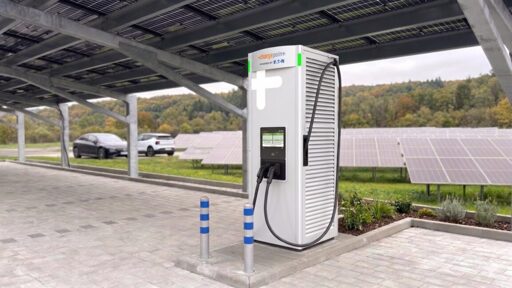
If charging speed is one of the major stumbling blocks preventing people from considering an electric vehicle, then ChargePoint’s new Express Solo DC fast charger is a step in the right direction. It has been designed to be compact and work with DC power, making it easy to install in tight spaces. Oh, and it maxes out at a hefty 600 kW.
As we saw with yesterday’s news from CATL, EV batteries are getting more and more capable by the day. Increasing power can reduce charge times, as long as the battery can take it—BYD’s new Blade battery can charge at up to 1.5 MW, and megawatt chargers are already common across China.
Once again, you can see how badly the US is lagging in EVs. Most Tesla Superchargers max out at 250 kW, Electrify America stops at 350 kW, and even the new IONNA stations top out at 400 kW per plug. So the Express Solo’s 600 kW—as powerful as a Formula E pit stop—sets a new benchmark, particularly for a standalone charger that could live in an urban gas station or convenience store parking lot.
In litres and MJ because SI units make it easy:
Approximately 34 megajoules per litre for petrol/gasoline.
50 litres filling up in 4 minutes = 1.25 litres/second pumping rate.lol don’t do calculations before coffee, let’s just say you’ve got a hi-flow pump doing 1l/sec.1 litre/second x 34MJ per litre = 34 MJ/second.
1 watt = 1 joule per second, so:
An average fill up runs at about 34 megawatts.
Most of that energy is lost because ICE are very inefficients. Still, impressive.
Also, it’s not possible to refill at home, and it’s expensive when there’s a war near an oil-producing country at the other side of the world.
Electrifying has this downside of slow recharge, but quite a lot of benefits as well.
I feel like it’s important to point out how inefficient an ICE engine is at turning that energy into useful movement however. There is a ton of stored energy in fuel, and very little of it is actually converted to useful energy.
The peak of internal combustion efficiency is only about 50% in ideal conditions, in a purpose-built engine. Your everyday commuter in real world conditions is going to be more in the 20% range. And that’s likely to drop as it ages and isn’t maintained absolutely perfectly.
So while a ton of energy is moving in that fuel up, little of it will ever be used. Especially when compared to an EV’s real world efficiency being around 80-85%.
That’s not nearly enough to turn a DeLorean into a time machine.