
• 2 Posts
  • 95 Comments
Joined 2 years ago
cake
Cake day: October 19th, 2023

help-circle
  • Now, I’m not one of those “muh free market” morons, but I also think that not every potentially-abusable business practice immediately deserves government regulation against it. By and large it seems that most customers really don’t care that much about this (myself included). The ability for customers to choose where they shop has regulatory power which I think a lot of people fail to recognise. If a behaviour is really repulsive, then customers will just not shop there, which provides a strong negative incentive against the behaviour in question, without any state intervention or enforcement resources required.

    An example of this working in practice is the practice of restaurants attempting to introduce tipping in Australia (where it is not customary to tip). Whenever a restaurant frequented by locals tries to force them to tip or makes it awkward to not tip, there is an immediate and strong negative reaction to it from the customers which usually causes the restaurant to give up on the idea.


  • They can track what people are buying just as well without needing to know who is buying what. If all they cared about was making sure they are stocking items that are popular with customers, they could just monitor how many of the item were scanned at the checkout counters.

    When you give your phone number to the store, it serves three functions:

    1. The rewards scheme encourages loyalty. Once you have spent hundreds at the store, they give you a minor discount on something small, which saves you only a little bit of money. You only need to decide to patronise this store one time over their competitors for this bribe to be worth it.
    2. By learning your shopping habits, they can offer you personalised advertisements to encourage you to buy certain products. For example, a grocery store chain which has a location near where I live has learned that I always buy a certain brand of cheese, and so occasionally they will try to tempt me with something like a 50 cent discount on that cheese, or they will send me a message saying “Hey do you still want (the cheese brand)? We have it in stock!”
    3. Some people, when putting things into their basket or shopping cart, will see the large, advertised discounted price and think “this item is reasonably priced”, but then they forget to put their phone number in when checking out and are thus charged the inflated price. The store pockets the difference as customers are unlikely to notice or complain about it. Most people do not closely monitor the price of items as they are being scanned. They only look at the total price at the end before tapping their card.

  • I don’t think a BRICS currency will be successful in replacing the dollar unless the governments of the participating countries force their businesses to use it. The reason why transactions are denominated and settled in US dollars is because of the perceived stability of its value and the openness of the US financial system to international trade. People use the US dollar because they trust the American government to not excessively devalue it and for it to be reliably useful later on.

    And yes, I recognise that all of these are under attack by the current US government.


  • This is not what I would consider a “political reason”. A political reason would be something like refusing to package it because of what political party Howard supports.

    There is plenty of software you’ll find in these repositories that aren’t under the GPL. CMake uses BSD, the Apache web server uses the eponymous Apache license, LibreOffice and Firefox use MPL, Godot and Bitcoin Core use the MIT license, and I’m sure there are plenty of other software licenses that I haven’t thought of yet.

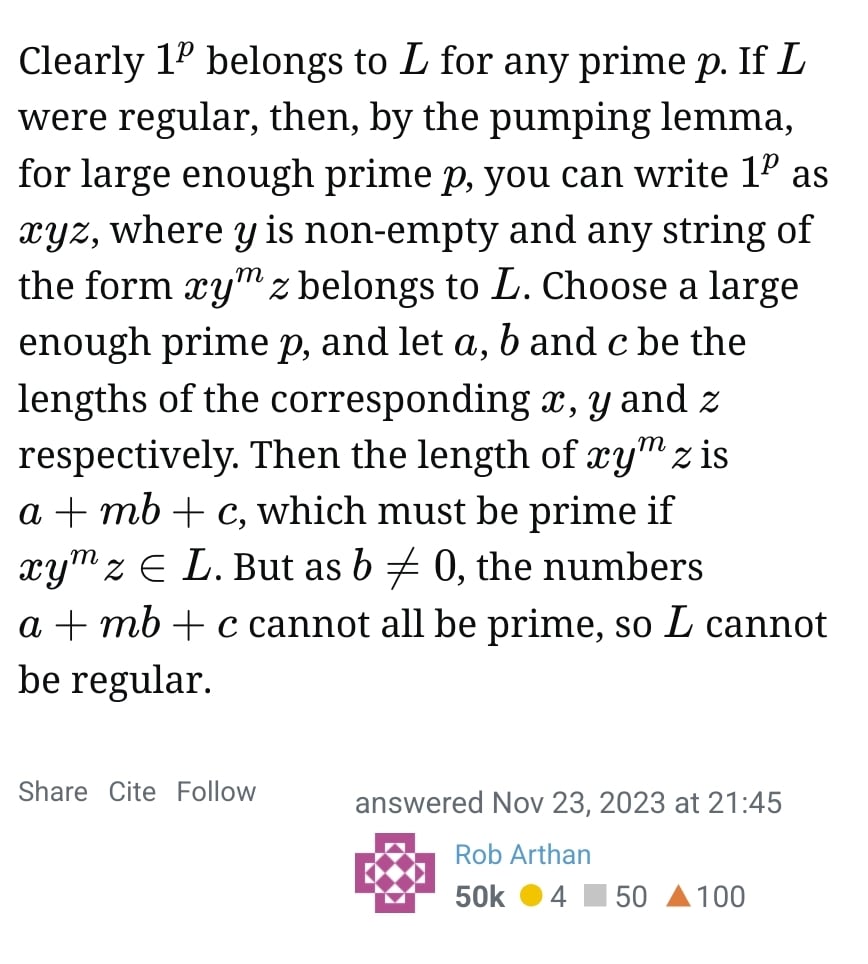


  • You got downvoted here but you’re absolutely right. It’s easy to prove that the set of strings with prime length is not a regular language using the pumping lemma for regular languages. And in typical StackExchange fashion, someone’s already done it.

    Here’s their proof.

    Claim 1: The language consisting of the character 1 repeated a prime number of times is not regular.

    A further argument to justify your claim—

    Claim 2: If the language described in Claim 1 is not regular, then the language consisting of the character 1 repeated a composite number of times is not regular.

    Proof: Suppose the language described in Claim 2 is regular if the language described in Claim 1 is not. Then there must exist a finite-state automaton A that recognises it. If we create a new finite-state automaton B which (1) checks whether the string has length 1 and rejects it, and (2) then passes the string to automaton A and rejects when automaton A accepts and accepts when automaton A rejects, then we can see that automaton B accepts the set of all strings of non-composite length that are not of length 1, i.e. the set of all strings of prime length. But since the language consisting of all strings of prime length is non-regular, there cannot exist such an automaton. Therefore, the assumption that the language described in Claim 2 being regular is false.


  • No, what I said is true if you use zero-based numbering. But when communicating with others in English, the label “first” refers to the element with the smallest index. In zero-based numbering, the label “zeroth” refers to the element with the lowest index. It’s just not the default in English, but you can definitely use zero-based numbering in English if you’re willing to edit the configuration files.


  • My argument is purely pedantic. Pedantry is the lifeblood of programmer “humour”.

    I’m not arguing that we should adopt zero-based numberingin real-life human applications. I am arguing that in zero-based numbering, the label “zeroth” refers to the same ordinal as “first” in one-based numbering. I am poking fun at the conversion between human one-based numbering and computers’ zero-based numbering. That is why I am saying it should be called zeroth(); because human language should adapt to match the zero-based numbering their tools use. Whether I actually mean what I say—well, I leave that up to you.

    It does not matter why indexes start from zero in computing. The memory offset argument is only salient if you are using it as an argument for why computers should use zero-based numbering. It is not an argument against the properties of zero-based numbering itself.


  • Zero-based indexing redefines the meaning of the labels “first”, “second”, “third”, and so on. It adds a new label, “zeroth”, which has the same ordinal value as “first” in one-based indexing. The word “first” does not mean “the element with the lowest index” in zero-based indexing.

    If you are using a zero-based numbering system, you would absolutely say that array[2] is the final element in the array, that element having the ordinal label “second”, and yet the length of the array is 3 (cardinal). There is no fundamental connection between the ordinal labels “zeroth”, “first”, “second”, and “third” and the cardinal numbers 0, 1, 2, and 3. The similarities are purely an artefact of human language, which is arbitrary anyway. You can make an equally mathematically valid ordinal numbering system that assigns “third” to the element with the smallest index, “fourth” to the next-smallest, and so on. That ordinal numbering system is mathematically coherent and valid, but you’re just causing trouble for yourself when it comes time to convert those ordinals (such as array indexes) into cardinals (such as memory locations or lengths of fencing to buy).

    You can make an argument for why one-based numbering is more convenient and easier to use, but you cannot use the notion that zero-based numbering doesn’t make sense given the assumed context of one-based numbering as an argument for why zero-based numbering is invalid.

    I encourage you read up what is meant by “zero based numbering” because you and everyone else who has replied to me has tried to use “but that’s not how it works in one-based numbering” as an explanation for why I’m wrong. This is as nonsensical of an argument as trying to say i (the imaginary unit) is not a number because it’s not on the number line. It’s only not a number in the domain of the real numbers. Similarly, zero-based numbering is only nonsensical in the context of one-based indexing.

    It does not matter why indexes start from zero. The memory offset argument is only salient if you are using it as an argument for why computers should use zero-based numbering.


  • Okay, I will admit, you got me there. I did confuse indexing with numbering. From now on I will use the term “numbering” instead.

    It is entirely how ordinal numbers work in zero-based numbering. There is no “right way” for ordinal numbers to work. You can create a valid ordinal numbering system starting from any integer, or just some other ordered list. You cannot assume one-based numbering is “correct” and use it as an argument against numbering beginning from any other number.

    I encourage you read up what is meant by “zero based numbering” because you and everyone else who has replied to me has tried to use “but that’s not how it works in one-based numbering” as an explanation for why I’m wrong. This is as nonsensical of an argument as trying to say i (the imaginary unit) is not a number because it’s not on the number line. It’s only not a number in the domain of the real numbers. Similarly, zero-based numbering is only nonsensical in the context of one-based indexing.

    Zero-based numbering would number “foo” as the zeroth element, “bar” as the first element, and “baz” as the second element. “zeroth”, “first”, and “second” are labels representing ordinals. Your list has a length of 3 (which is a cardinal quantity unrelated to ordinals).

    Although, I would like to point out, it is perfectly valid to construct an ordinal labelling system that assigns “fifth” to the element with the lowest index, “sixth” to the next, and so on. That system is mathematically coherent but it is just troublesome to when it comes time to convert ordinal numbers (such as the index of the last fence-post) to cardinal numbers (such as the length of fence to buy).

    But this is now getting into the weeds of pure mathematics and most people here are engineers.


  • NateNate60@lemmy.worldtoProgrammer Humor@lemmy.mlOff by one solitude
    link
    fedilink
    arrow-up
    3
    arrow-down
    1
    ·
    edit-2
    1 year ago

    That’s because the word “first” in first() uses one-based indexing. In true programmer fashion it would have been called zeroth() but that is wholly unintuitive to most humans.

    I maintain that the element with the lowest index is called the “zeroth” element in zero-based indexing and “first” in one-based indexing. The element with index N is the Nth element.