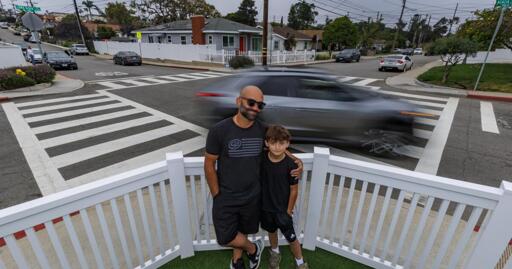
Joseph Brandlin, who has lived in El Segundo for more than four decades, says he took matters into his own hands after months of trying to get the city officials to address safety concerns.
As much as this case might have been justified (which we just don’t know without the traffic study), condoning random people fucking with street signage is a terrible idea. There are very good reasons not to randomly change traffic patterns, especially outside of a popular park; fuckcars, but also vigilante traffic engineering is an insanely dangerous game to play. If this brings attention to it and they reevaluate, well done this traffic martyr. But he absolutely should have been arrested for this, if only to prevent a precedent for people who decide to “fix” other traffic issues.
Nah, this road is a fucking textbook example of a bad neighborhood intersection.
Wide straight road with a hill on one side leads to unsafe driving speeds. Combined with parking at the intersection making visibility low for anyone crossing the intersection (cars, pedestrians, and bikes all included!)
This intersection needs intervention, and a stop sign is a bare minimum solution. Speed bumps and daylighting would also be justified.
We know we build unsafe intersections, we don’t need a traffic study to confirm it, especially if you have a large number of residents with the same complaint.
Sure! And if improvement is warranted hopefully this will bring enough attention that it gets reevaluated. But that all said, even if he was right, being arrested for it is warranted. Hopefully he was right and as a result he’s not punished, but if the only requirement for infrastructure changes was community complaint there would be no speed limits and the bones of traffic engineers would hang from every street light.
People taking down speed limits signs cause they want to go faster does not warrant the same response as people complaining that an intersection is unsafe and trying to improve it, and only because the city is basically ignoring them.
It’s exactly the same - someone is changing the signage without knowing what they’re doing. I don’t think he should be harshly punished in this case, especially if he’s right, but this also isn’t at all different from someone fucking with the speed limit signs because they feel they know best. That person may also be right - that doesn’t mean they should be able to make those changes.
You’re punishing him solely to potentially prevent others from doing copying him. Which frankly is insane. Cause lets be honest, he was more than likely right, so punishing him isn’t going to make him regret what he did. He would probably do it again under similar circumstances. If his work is undone by the city, then not only will it make his sacrificd meaningless, it will also likely make him and others want to escalate. If his actions do work, whether or not he is punished, it serves as proof that his strategy works, and if people are desperate enough they will copy him. Then lastly the people who want to fuck with traffic stuff just for the fun of it are not going to be the kinds of people deterred by the possibility of getting arrested.
Punishing him not only won’t stop shit, it further proves him right. Making an example of him is punishing a man for doing the right thing when the city wouldn’t and is unproductive and wrong. The city shoulda just put the stop sign in and none of this would have been an issue.
Traffic engineering is an actual science - what he did was extremely well-meaning, but it’s also the pavement equivalent of alternative medicine. Sometimes you’re right, but even if you nail the diagnosis most of the time you’re so ignorant you don’t even understand the potential harm you’re doing in brewing up your own treatment. It is very possible that his traffic revisions have made the area less safe for pedestrians by shifting traffic congestion onto surrounding roads with worse sightlines and higher non-motor vehicle traffic, or simply increasing baseline congestion at this already busy intersection.
It may be a science, but that doesn’t place it in some rarefied air of infallibility, any more than any other science. It’s only ever as good as how it’s applied, and how any science is applied is always subject to human fallibility. Traffic engineering is especially bad in that respect, routinely and as a matter of course being subverted by political considerations, not least by the fundamental choices about who and what matters, and who and what does not matter. It does not deserve much respect as a practice.
But with that said, in this case, even the traffic engineers agreed that a stop sign was an appropriate treatment for this intersection when they rejected it on the basis that the traffic volume wasn’t high enough to warrant installing one. Presumably, if there were more cars, it would be fine. So, yes, we can say confidently that this man made the area safer.
even the traffic engineers agreed that a stop sign was an appropriate treatment for this intersection when they rejected it on the basis that the traffic volume wasn’t high enough to warrant installing one
They allegedly did a study to see whether there was enough traffic, a step which requires a certain commitment of resources. If the placement of a stop sign would’ve harmed safety by displacing traffic flow, then they could’ve cited that without spending time on a study. But they didn’t, from which we can conclude that a stop sign is okay there.
That’s a decent example of what I’ve been saying - basing a conclusion like that on the wording of an uncited press statement is pretty spurious. There simply may have been more reasons and this was judged the easiest to explain (which happens frequently), and without more information we simply aren’t equipped to make an informed judgement. Much as he wasn’t when he made the initial decision, but admittedly we’re facing far less severe consequences for being wrong.
Much like that park bathroom that was going to cost something like $2M to install in San Francisco. Once the residents and news got ahold of the story, suddenly the bathroom would only cost $100k to install.


Bureaucracy at its finest
As much as this case might have been justified (which we just don’t know without the traffic study), condoning random people fucking with street signage is a terrible idea. There are very good reasons not to randomly change traffic patterns, especially outside of a popular park; fuckcars, but also vigilante traffic engineering is an insanely dangerous game to play. If this brings attention to it and they reevaluate, well done this traffic martyr. But he absolutely should have been arrested for this, if only to prevent a precedent for people who decide to “fix” other traffic issues.
Nah, this road is a fucking textbook example of a bad neighborhood intersection.
Wide straight road with a hill on one side leads to unsafe driving speeds. Combined with parking at the intersection making visibility low for anyone crossing the intersection (cars, pedestrians, and bikes all included!)
This intersection needs intervention, and a stop sign is a bare minimum solution. Speed bumps and daylighting would also be justified.
We know we build unsafe intersections, we don’t need a traffic study to confirm it, especially if you have a large number of residents with the same complaint.
Sure! And if improvement is warranted hopefully this will bring enough attention that it gets reevaluated. But that all said, even if he was right, being arrested for it is warranted. Hopefully he was right and as a result he’s not punished, but if the only requirement for infrastructure changes was community complaint there would be no speed limits and the bones of traffic engineers would hang from every street light.
No it’s not the same.
People taking down speed limits signs cause they want to go faster does not warrant the same response as people complaining that an intersection is unsafe and trying to improve it, and only because the city is basically ignoring them.
It’s exactly the same - someone is changing the signage without knowing what they’re doing. I don’t think he should be harshly punished in this case, especially if he’s right, but this also isn’t at all different from someone fucking with the speed limit signs because they feel they know best. That person may also be right - that doesn’t mean they should be able to make those changes.
But it’s literally the same law, if they enforce one they have to enforce the other.
It is the same though, it goes both ways
You’re punishing him solely to potentially prevent others from doing copying him. Which frankly is insane. Cause lets be honest, he was more than likely right, so punishing him isn’t going to make him regret what he did. He would probably do it again under similar circumstances. If his work is undone by the city, then not only will it make his sacrificd meaningless, it will also likely make him and others want to escalate. If his actions do work, whether or not he is punished, it serves as proof that his strategy works, and if people are desperate enough they will copy him. Then lastly the people who want to fuck with traffic stuff just for the fun of it are not going to be the kinds of people deterred by the possibility of getting arrested.
Punishing him not only won’t stop shit, it further proves him right. Making an example of him is punishing a man for doing the right thing when the city wouldn’t and is unproductive and wrong. The city shoulda just put the stop sign in and none of this would have been an issue.
Nah, this was stupid. If he felt obligated to fix something broke, it’s on the county/town, not him. All he did was make the area safer.
With respect, you have no idea if that’s true.
Traffic engineering is an actual science - what he did was extremely well-meaning, but it’s also the pavement equivalent of alternative medicine. Sometimes you’re right, but even if you nail the diagnosis most of the time you’re so ignorant you don’t even understand the potential harm you’re doing in brewing up your own treatment. It is very possible that his traffic revisions have made the area less safe for pedestrians by shifting traffic congestion onto surrounding roads with worse sightlines and higher non-motor vehicle traffic, or simply increasing baseline congestion at this already busy intersection.
It may be a science, but that doesn’t place it in some rarefied air of infallibility, any more than any other science. It’s only ever as good as how it’s applied, and how any science is applied is always subject to human fallibility. Traffic engineering is especially bad in that respect, routinely and as a matter of course being subverted by political considerations, not least by the fundamental choices about who and what matters, and who and what does not matter. It does not deserve much respect as a practice.
But with that said, in this case, even the traffic engineers agreed that a stop sign was an appropriate treatment for this intersection when they rejected it on the basis that the traffic volume wasn’t high enough to warrant installing one. Presumably, if there were more cars, it would be fine. So, yes, we can say confidently that this man made the area safer.
I’m not sure I follow your reasoning here.
They allegedly did a study to see whether there was enough traffic, a step which requires a certain commitment of resources. If the placement of a stop sign would’ve harmed safety by displacing traffic flow, then they could’ve cited that without spending time on a study. But they didn’t, from which we can conclude that a stop sign is okay there.
Ah, I understand. Thank you.
That’s a decent example of what I’ve been saying - basing a conclusion like that on the wording of an uncited press statement is pretty spurious. There simply may have been more reasons and this was judged the easiest to explain (which happens frequently), and without more information we simply aren’t equipped to make an informed judgement. Much as he wasn’t when he made the initial decision, but admittedly we’re facing far less severe consequences for being wrong.
Thanks for the excellent reply. I don’t exactly agree, but I love that it’s logical, clear, and respectful.
Much like that park bathroom that was going to cost something like $2M to install in San Francisco. Once the residents and news got ahold of the story, suddenly the bathroom would only cost $100k to install.