

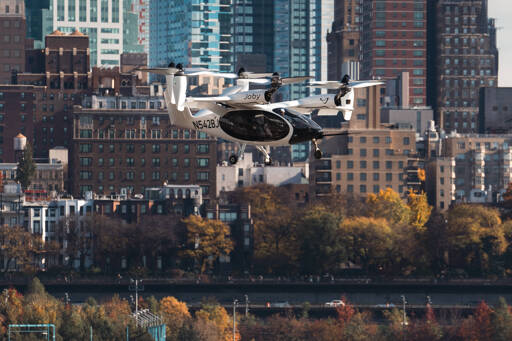
Autonomous vehicles are already doing so well with two dimensions, why not add a z-axis?
The skies over parts of the US could soon get busier, as the Federal Aviation Administration launches pilot projects spanning 26 states to test electric air taxis and other next-gen aircraft, with operations expected to begin by summer 2026.
Selections for the electric vertical takeoff and landing (eVTOL) Integration Pilot Program (eIPP) were announced by the FAA on Monday, with eight projects chosen to participate in the initiative. The program will run for three years after the first project begins operations, and the selected efforts span 26 states.
According to the FAA, the projects will explore operational concepts including urban air taxi services, regional passenger transportation, cargo and logistics networks, emergency medical response operations, autonomous flight technologies, and offshore or energy-sector transportation.
“These partnerships will help us better understand how to safely and efficiently integrate these aircraft into the National Airspace System,” said FAA Deputy Administrator Chris Rocheleau. “The program will provide valuable operational experience that will inform the standards needed to enable safe Advanced Air Mobility operations.”
Adding a z axis means that they can move in a much straighter and less rigid path, though. A car can only turn left or right or change its velocity to avoid things, whereas a flying vehicle can also go up or down, with the added benefit that there’s a lot less to run into up in the sky.
Depends how many other vehicles are “up in the sky.”
The Z axis adds more than just a direction. Thrust, Lift, Stalls, Icing, Wind, Clouds, Precipitation, Temperature, Humidity, Radios, Communication, Flight Planning…
Car manufacturers got really good at adding crumple zones to cars to avoid injury to their occupants. Car design knows to avoid putting the fuel tank in places that could cause it to combust. What crumple zone can a flying taxi have that protects you from hitting the Earth during a stall? Where can they put the fuel such that it doesn’t explode on impact with just about anything?