

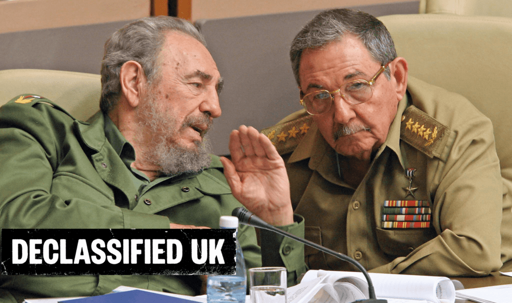
After the US cut off diplomatic relations with Cuba in January 1961, the British embassy in Havana functioned as a proxy for US covert action and intelligence gathering against Castro’s government.
British operations, undertaken by the Foreign Office’s Information Research Department (IRD), were designed to delegitimise Cuba’s promotion of wealth distribution and to support US attempts to overthrow Castro.
The IRD, a cold war propaganda unit, sought to censure key Cuban officials and even plotted to spread homophobic rumours about Fidel’s second in command and brother, Raúl Castro.
Newly-released British files also show that during the 1970s, the IRD produced forged documents in an attempt to attack Cuba’s anti-apartheid campaigns in Africa.
[…]
While the US effort to overthrow Castro is infamous, very little is known about British operations in Cuba.
In August 1962, Leslie Boas, Britain’s regional information officer for Latin America based in Caracas, Venezuela, circulated a report on the leading political personalities in Cuba. “Having read the report”, Boas noted, “it has occurred to me that we could make effective use of some of the information it contains for propaganda purposes”.
He continued: “We could put out, in a completely unattributable fashion, a leaflet entitled ‘Personalities of the Cuban Revolution’ in which the more dubious aspects of the leading figures in the Cuban scene would be highlighted”.
The IRD was asked to “do some research” in order to produce additional “ammunition” on Castro’s aides.
To this end, senior IRD official Rosemary Allott suggested the unit “might include suitable stories circulating in Cuba (I heard one in Havana – since forgotten – on Raul Castro as a homosexual). In fact we might ask Havana for other purposes to send us all counter-revolutionary jokes and stories”.
[…]
In March 1962, shortly after the US initiated Operation Mongoose, a British embassy official in Washington wrote to the Foreign Office in London about a meeting with the US State Department and “our Friends”, a reference to the CIA.
“They would… be very grateful for facts on what is going on in Cuba which they can use in their propaganda and any suggestions the Embassy in Havana may have on useful topics and themes”, the British embassy official noted.
In a document marked Top Secret, Foreign Office official Robert Marrett noted that: “It seems to me to be a sound idea that our Embassy in Cuba should also assist the Americans discreetly by supplying anti-Castro material”.
By June 1962, an operation to send “useful items to the Americans for propaganda purposes” had been “approved by the Foreign Office”.
this seems to mirror the fear in the early decades of the soviet union that queers would be used to create kompromat for leverage over russians; so the soviet gov’t made homosexuality illegal.
so it’s interesting that western powers now leverage pink washing to justify their monstrous behavior enacted on the global south.
Interesting, I frequently heard as a UK child that “you shouldn’t like Che Guevara because he killed people for being gay”. Sounds like that myth may literally have originated as official disinformation propaganda.
You don’t airways hear about the British operations.