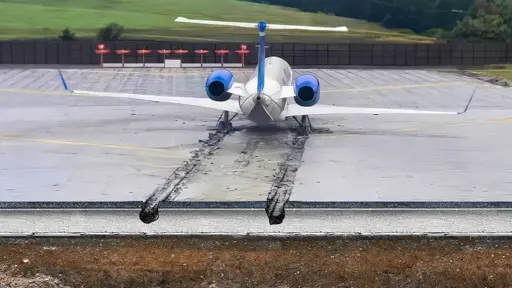
[Note that this article is a transcript of the video embedded above.] September 2025 was an unusually bad month for runway overruns in the US. On the night of September 24th, an Embraer 145 with 53 people on board landed long at the Roanoke-Blacksburg Regional Airport in Virginia, overshooting the
I was mildly scared of them when I was getting my commercial driver’s license ages ago. I was looking at potential jobs involving cranes or an excavator and lowboy. When a typical tractor trailer is fully loaded, you only have 3-4 full hard presses on the brakes before you lose them. Air brakes are inverted. The unpowered brakes state is fully engaged. The pneumatics are holding back the shoes; unlike typical cars that are pressing the friction material into a surface using hydraulics. When a truck fully engages the brakes, it lets all the air out. Then the reserve is used to refill the system to disengage. The engine’s compression is a primary component of the braking system. However, it is a manual transmission. Unlike manual cars, these do not have synchromesh (small clutches that spin up the secondary gear shaft to match the primary shaft speed). If you miss a shift, you only have around a 50-75 RPM window where shift will mesh at all. On top of that, the engine only revs 2k-3k RPM, so the transmission is usually an 8 speed with 2-3 splitters. That means there are 16-24 speeds total, and for any given speed, only one little shift window exists. I was scared of big downhills. When a truck is fully loaded, going down hill, and you’ve got to shift for engine braking, it can feel about like someone is fully depressing the accelerator in a regular car. That shift window passes super fast. One can rev match the engine to a small extent, but it is still easy to miss in an unfamiliar rig. You are more focused on staying in the lane when every visual indication you’re used to in cars is missing. Like you feel much larger than the lane and you only have around half a meter of extra margin split on both sides of the truck when driving minimum width lanes. So you miss the gear mesh, now you hard press the brakes to get the speed somewhere low where you are able to find a gear. Miss like that 3 times in a few minute span, and you’re likely to run out of air. That slams on the brakes, but that is not enough to stop a fully loaded truck on grades steeper than 5-6%. It is why the signs exist warning about the grade. You must use the engine AND brakes at these grades, managing the air levels in concert with the RPM and gear selected.
Anyone here ever fucked that up, or been in to a runaway ramp or engineered stopping surface?
It still sort of baffles me we haven’t designed a better braking system for the heaviest and most dangerous vehicles on the road. I’m sure it’s not easy but it seems to me like society is taking the “eh, it’s dangerous but a good truck driver will prevent it” stance instead of “the breaks shouldn’t fail”.
Nah, it is a matter of weight. Roads are engineered specifically for the weight of these trucks. If these trucks are regulated stupidly, the cost of goods goes up very quickly, the cost of road infrastructure skyrockets, or both. Making cars obese to protect the dumbest humans is one thing, but the constraints are different here. A commercial driver’s license is supposed to be a real license with real qualifications. That is your only protection. In a society where driving is required, the regular license is a joke with superficial qualifications. It is just a tax on the populous.


Anyone here ever driven in a runaway trap system?
I was mildly scared of them when I was getting my commercial driver’s license ages ago. I was looking at potential jobs involving cranes or an excavator and lowboy. When a typical tractor trailer is fully loaded, you only have 3-4 full hard presses on the brakes before you lose them. Air brakes are inverted. The unpowered brakes state is fully engaged. The pneumatics are holding back the shoes; unlike typical cars that are pressing the friction material into a surface using hydraulics. When a truck fully engages the brakes, it lets all the air out. Then the reserve is used to refill the system to disengage. The engine’s compression is a primary component of the braking system. However, it is a manual transmission. Unlike manual cars, these do not have synchromesh (small clutches that spin up the secondary gear shaft to match the primary shaft speed). If you miss a shift, you only have around a 50-75 RPM window where shift will mesh at all. On top of that, the engine only revs 2k-3k RPM, so the transmission is usually an 8 speed with 2-3 splitters. That means there are 16-24 speeds total, and for any given speed, only one little shift window exists. I was scared of big downhills. When a truck is fully loaded, going down hill, and you’ve got to shift for engine braking, it can feel about like someone is fully depressing the accelerator in a regular car. That shift window passes super fast. One can rev match the engine to a small extent, but it is still easy to miss in an unfamiliar rig. You are more focused on staying in the lane when every visual indication you’re used to in cars is missing. Like you feel much larger than the lane and you only have around half a meter of extra margin split on both sides of the truck when driving minimum width lanes. So you miss the gear mesh, now you hard press the brakes to get the speed somewhere low where you are able to find a gear. Miss like that 3 times in a few minute span, and you’re likely to run out of air. That slams on the brakes, but that is not enough to stop a fully loaded truck on grades steeper than 5-6%. It is why the signs exist warning about the grade. You must use the engine AND brakes at these grades, managing the air levels in concert with the RPM and gear selected.
Anyone here ever fucked that up, or been in to a runaway ramp or engineered stopping surface?
It still sort of baffles me we haven’t designed a better braking system for the heaviest and most dangerous vehicles on the road. I’m sure it’s not easy but it seems to me like society is taking the “eh, it’s dangerous but a good truck driver will prevent it” stance instead of “the breaks shouldn’t fail”.
Nah, it is a matter of weight. Roads are engineered specifically for the weight of these trucks. If these trucks are regulated stupidly, the cost of goods goes up very quickly, the cost of road infrastructure skyrockets, or both. Making cars obese to protect the dumbest humans is one thing, but the constraints are different here. A commercial driver’s license is supposed to be a real license with real qualifications. That is your only protection. In a society where driving is required, the regular license is a joke with superficial qualifications. It is just a tax on the populous.
Just replying here that I would also like to know. Thank you for this wonderful comment.