

Ivry: Back in 2023, you wrote an essay, a speculative essay called “A Public Option for Social Media.” And in this hypothetical public option for social media, it would be state run, and it would be called StateBook. Can you tell us a little bit about this idea of StateBook? What would it be? How would it work? And why are you laughing?
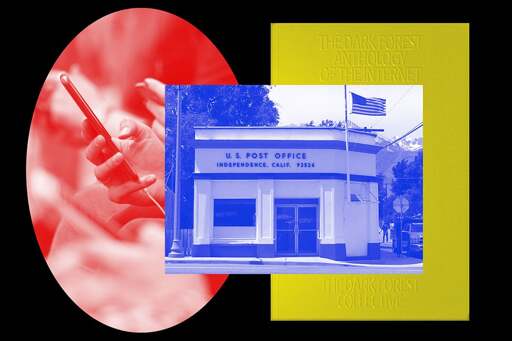
Citarella: That’s, I mean, it’s a, it feels a little bit silly but like most things on the internet in the last few years, it starts as a joke and then you realize, actually, it could be quite important. StateBook was a kind of hyperbolic meme or an exaggeration that myself and a few friends in reading groups, probably back around 2011, came up with, which was, just as a thought experiment, you know, Facebook is very new at this time: What if the United States government decided to, overnight, nationalize Facebook and make it a digital division of the post office. What would that look like? How would that fundamentally transform the platform of Facebook and then the institution of the post office?
And so that kind of spurred this long form investigation of just really trying to articulate what the difference between private and public solutions are and the unique things that become available once you are no longer constrained by the parameters of the private sector. There’s a lot of things in society for which markets just fail to function, they fail to allocate resources or to accomplish what you need them to do. And so those are the spaces in which the public sector really needs to step in.
And so, in 2023, this was a kind of joke that was entertained by myself and a few other scholars, academics, or what have you. But maybe as an exercise, it would be useful to kind of play the whole thing out and to come up with a policy prescription and get really granular down to the cost of digital stamps and just how exactly you would build this thing and then all the functions that it would perform. So, StateBook was, yeah, my attempt to kind of, in as serious and silly way as possible, to explain how that public institution would work.
Now, I think the important thing to mention for StateBook is that, as is the case with a lot of these platforms, the social component is what encourages people to get onboarded, because they want to obviously connect with their family and friends, which is why we all join social media. But that is not the end goal of it. Where the end goal of something like Facebook is to get everybody on there to create a platform in which social interaction is trackable, can be surveilled, and then to generate new advertising insights from mining all those small social interactions, StateBook is offering the bare bones of a social media component as the attractive onboarding service to get you into a portal in which you can interact with all of these other state services, which will then be behind this kind of closed, walled garden, that if you’re trying to file your taxes through an H&R Block—not to single them out or any of these Turbo Tax type of people, maybe H&R Block should be singled out because they lobbied the IRS to not implement this feature—but it is a fairly simple technical task to be able to pre-fill out your tax filings once a year. And all of those things should be behind the walled garden of a public platform. And yeah, same thing as you go to the DMV, to register to vote. So, you know, you’ll get on there to see, like, your cousin’s baby pictures and things like that. That makes it very attractive to join, but we’re really kind of onboarding people into having these digital public space interactions.
And I think the last thing that I would say about it is that there has been an enormous discussion and rhetoric around how competitive these platforms need to be, and why a lot of their unscrupulous behavior is permissible because there is real competition, especially at the early years of different network effects and needing to saturate the market. And well, if platform A doesn’t do it, then platform B will, and we’ve kind of set up this permission structure in which generally everything is permissible, whether it is literally illegal in some cases or it is just socially corrosive, but we’ve given these platforms basically unfettered license to behave in any way that they want, because this is the competitive, coercive laws of the market, and it’s just unavoidable. And they’ve got to scale otherwise they’re going to go under and go out of business.
I think my favorite part of the proposal for StateBook is that its market saturation rate is 100 percent. It’s literally the government, and every citizen has a profile that’s verified under their name, and everybody is a part of it. There’s no rush to onboard people, because you’re already given it as your right of citizenship at birth. And so all of a sudden, once you have everyone involved in a mandatory level, you don’t have to entertain any of these like, “Well, Facebook had to sell this data to this company because they had to expand, and if they didn’t expand then the company would go under,” and just all of these kind of constraints of like why we should excuse all of their socially corrosive and predatory behavior. Everybody’s already a part of it. It’s affordable. And yeah, you start to eliminate a lot of those problems when you give yourself license to start thinking of this thing as a public institution rather than a private platform.
I’ve been saying since a long time, the only way a social network makes sense is if it’s public. It’s a public forum, just like the central square in a city, it makes zero sense giving private companies the kind of power that comes with controlling it.
Yet there’s like 14 people here on the fediverse, where this issues been largely solved.
It’s growing, and I don’t really want the herds and their mindrot either, but it’s the way of the future. Look at the god damn situation we find ourselves in, for example. That’s almost solely to be blamed on social media.